



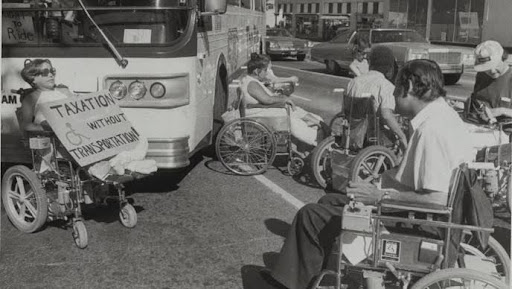
18 Aug NPR Podcast about the “Gang of 19” 1978 Protest Features the Central Role Denver Advocates Played in the Disability Rights Movement and the ADA
In the last few years, there have been several documentaries about the vital role the Denver disability rights movement and the “Gang of 19” played in making Denver the first fully accessible bus transit system in the world and in leading the push for passage of the Americans with Disabilities Act (ADA).
On The Sunday Story, NPR’s Joseph Shapiro and Colorado Public Radio’s Stephanie Wolf trace the history of the disability rights movement—from the brave Gang of 19 protests starting in Denver that secured accessible public transit to the continuing battle to protect the hard-won right to live independently. NPR has done a very spirited national retelling of the important role Denver disability advocates played through their protests continuing to and beyond the passage of the ADA in 1990.
Here is a link to the podcast which ran on July 26, 2026: https://www.npr.org/2026/07/26/nx-s1-5906442/the-1978-protest-that-sparked-the-disability-rights-movement (Or download the PDF)
John had the privilege of representing this extraordinary movement. While at Legal Aid, he brought one of the earliest lawsuits to prevent Denver RTD from taking possession of more than 250 new buses without first making them wheelchair accessible by installing lifts. Before filing suit he secured RTD’s agreement that the new buses would be initially designed in such a way as to be readily retrofitted to accept such lifts if legally required.
After an initial round loss in Court, 19 disabled persons, mostly young adults, surrounded two RTD buses in broad daylight at Colfax and Broadway in Denver during rush hour and kept them there, snarling traffic, by camping out around them in the street for two days. The police and Mayor did not know what to do. They did not want to be seen as “fall guys” arresting the disabled protesters, so they arrested their attendants and charged only them with failing to obey police orders to get out of the streets.
In a Court evidentiary hearing, John successfully challenged these arrests of the able-bodied supporters of the protesters as unconstitutional discriminatory selective enforcement of the law. The protesters themselves had a right to be arrested for their actions. View the original Denver Post article about the dismissal of these charges.
The disability protest movement sparked by the Gang of 19 spread thereafter all over the Country. Members of that original protest went on to be arrested many times, along with disabled citizens everywhere, as they all fought for accessible public transportation and what would ultimately much more broadly become the landmark Americans with Disabilities Act (ADA).
Through a combination of sustained disabled persons protests, most notably by the “Gang of 19” and the ongoing litigation, RTD settled the lawsuit on appeal, agreeing to retrofit all the buses it had just bought, and to make all future buses fully accessible.
Most of the Gang of 19 protesters were also refugees from and victims of an intolerable group situation of severe neglect and abuse in a Lakewood Nursing home. To get them out of that nursing home, Denver’s Wade Blank, the nursing home’s former activity director, who went on to become the nationally recognized leader of the disability rights movement and cofounder of the Atlantis Community along with Barry Rosenberg, rescued and moved numerous residents out of the nursing home into public housing units. The Atlantis Community also became one of the first independent living attendant care programs in the world.
Wade Blank learned non-violent civil disobedience from marching with Dr. King in Selma.
John also sued the nursing home for damages on behalf of a class of all residents. The suit drove the nursing home into bankruptcy and also resulted in Court orders compelling major reform of the entire national nursing home inspection system. After more years of litigation against the facility, several million dollars in insurance were obtained, allowing a number of the gang of 19 protesters to purchase their own homes while also exercising their rights to be in the world by using the accessible public transportation system for which they had fought so hard.